Feeding
Paced Bottle Feeding And Why It Slows Things Down
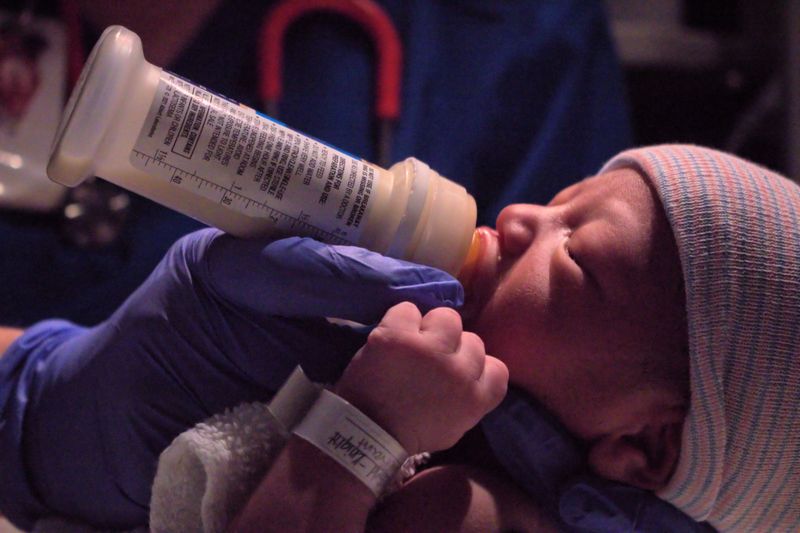
A bottle held level rather than tipped changes how hard a baby has to work, which is the whole reasoning behind the technique lactation staff describe as paced feeding.

Paced bottle feeding is a way of holding a bottle rather than a schedule or a product. The reasoning behind it is about gravity and about who controls the flow.
Gravity does the work in a tipped bottle
Held at a steep angle, a bottle delivers milk whether or not the baby is actively drawing on it. The liquid arrives, and the baby's job becomes swallowing fast enough to keep up.
Held closer to level, the nipple fills only partly and the baby has to generate suction to move milk. Effort and reward are reconnected, which is the point of the technique.
The baby is more upright in this position rather than reclined, which also changes the geometry of swallowing and the amount of air arriving alongside the milk.
Fast flow overrides the pause a baby would take
Babies feeding at the breast pause frequently. Those pauses are part of how the feed is regulated, and they give time for the signals that eventually register fullness.
A fast bottle can outrun that rhythm. Milk keeps coming, swallowing continues reflexively, and the feed finishes before the pauses that would normally have punctuated it had a chance to occur.
Slowing the delivery restores the gaps. Caregivers using the technique typically tip the bottle down periodically, letting the baby rest without removing the nipple entirely.
The technique exists mostly for combination feeding
The approach became common in settings where babies move between breast and bottle. If the bottle is dramatically easier, the difference between the two can become a problem for the feeding relationship.
Narrowing that gap is the practical aim. A bottle that requires work is closer to the breast in effort, which makes moving between them less abrupt for the baby.
It is also used with babies who consistently finish bottles very quickly, or who show discomfort afterward, though the reasons behind either can be varied and are worth raising clinically.
Watching the baby beats watching the bottle
The signals caregivers are taught to look for are behavioral: widening eyes, splayed fingers, milk escaping at the corners of the mouth, or a change in the swallowing rhythm.
Those cues indicate the flow has got ahead of the baby. The response is a pause rather than persistence, and the feed resumes when the baby settles back into a steady pattern.
Finishing every bottle is not the goal in this framing. Leaving milk is treated as information rather than as failure, which is a different mental model than measuring intake against a target.
Where a professional belongs in this
Difficulty with bottles can reflect nipple flow rate, positioning, or something about the individual baby that no technique will resolve on its own.
Coughing, color changes, persistent choking or feeding that consistently distresses a baby are reasons to be seen rather than to keep adjusting the angle. Feeding and swallowing problems are assessed clinically.
Lactation consultants and pediatric feeding specialists demonstrate this in person because the corrections are small and physical. A description in text is a starting point, not a substitute for being shown.
Questions readers ask
When should allergens be introduced?
This differs by country and has been revised, so take it from the health body where you live. If there is any family history of allergy, speak to a professional first.
My mother says to delay certain foods. Is she right?
She may be describing advice that was current when she was following it. Guidance has changed in several countries, so check the current version published where you live.
Also by Shalu Prasad
- The fourth trimester is a framing, not a diagnosis, and it helps anywayThe Newborn Weeks
- Nobody warns you about the two-week visitor waveThe Newborn Weeks
- The first fortnight at home is a logistics problem nobody set up for youThe Newborn Weeks
- Crying often peaks in the early weeks before it easesThe Newborn Weeks