Feeding
Baby-led weaning and purées are not opposing camps
The two approaches are presented as a choice with a right answer, and most families end up doing some of both. The differences are practical rather than ideological.

Treat the sections below as a sequence. With weaning approaches, getting the early decisions right makes the later ones much easier.
Before you start
- Most families combine approaches rather than choosing one.
- The evidence does not strongly favour either for most outcomes.
- Choking safety guidance applies identically to both.
Two descriptions of the same destination
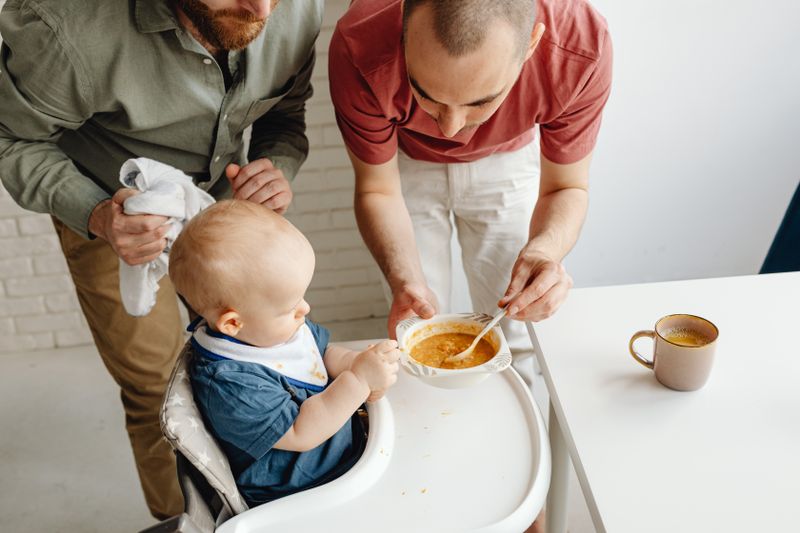
Purée-led weaning starts with smooth food on a spoon and progresses through textures towards family food over months. Baby-led weaning skips the spoon stage and offers appropriately prepared pieces of food that the baby handles themselves from the start. Both end at the same place, which is a child eating what the household eats, and they mostly differ in the route and the mess.
Presented as a binary choice, they generate a great deal of argument that the underlying practical differences do not really support. In practice a large proportion of families do both, often on the same day, which is unremarkable rather than a compromise.
What is actually claimed
Advocates of baby-led weaning point to self-regulation, exposure to textures and the baby participating in family meals from the start. Advocates of purées point to control over intake, easier introduction of a wide range of foods and rather less mess.
Research comparing the approaches exists but is limited in size and duration, and the differences found have generally been modest. Claims that either approach produces markedly different long-term outcomes go beyond what the current evidence supports. Saying that plainly is more useful than joining a side, particularly for a parent trying to decide in a supermarket.
The practical differences
Purée feeding requires preparation, storage and a spoon, and it is easier to do while out of the house or in a hurry. Baby-led weaning requires almost no preparation beyond cutting food appropriately and produces a considerably larger amount of mess.
Baby-led approaches also mean less certainty about how much has been eaten, which some parents find relaxing and others find stressful. For households where both parents work, the practical question of who has time to prepare what often decides it more than any principle. Choosing on logistics rather than on philosophy tends to produce an arrangement that survives longer.
Choking, gagging and safety
Both approaches carry the same requirement to prepare food safely, and national guidance covers shapes, sizes and foods to avoid. Gagging is common, is not the same as choking, and is part of how babies learn to manage food, though it is alarming to watch.
Choking is a different and serious event, and knowing what to do about it is worth learning properly on a first aid course. The guidance on food preparation differs by country, so take it from the health body where you live rather than from a book about one approach.
A baby should always be sitting upright and supervised while eating, regardless of which approach is being used.
Doing both
A common pattern is purées or mashed food for meals where intake matters and finger food alongside for practice and participation. Another is spoon feeding at home and finger food when out, or the reverse, depending on which produces less mess in the situation. Loading a spoon and letting the baby take it is a hybrid that borrows from both and works well for many families.
For a first baby, none of this confuses babies, and the idea that mixing approaches causes problems does not have much behind it. The useful test is whether mealtimes are going reasonably well, not whether they conform to a described method.
Safe sleep and feeding guidance is set nationally and updated periodically, so follow the current official guidance where you live over anything general.
When to seek advice
Any concern about eating, swallowing, weight or a baby who is not progressing with textures should go to a health visitor or doctor. Babies with additional needs, medical conditions or a history that might be relevant should have the approach discussed with a professional first. Speech and language services in some countries deal with feeding difficulties, which is not obvious and is worth knowing about.
Around the four-month mark, nothing about either approach should be pursued past the point where it is causing distress to the baby or the household. A conversation with someone who can see the baby resolves more than another book about a method.
The takeaway
Pick on logistics rather than principle, expect to do some of both, and take the food safety rules from your national guidance.
Nothing in the first year lasts, including the parts that feel permanent at three in the morning.
Questions readers ask
Which approach is better?
The evidence does not strongly favour either for most outcomes. Choose on what fits your household, and note that most families end up combining them.
Is baby-led weaning riskier for choking?
Safe preparation matters in both approaches, and national guidance covers it. Learning what to do about choking on a first aid course is worth doing whichever route you take.