Feeding
The first spoonfuls are practice, not nutrition
Early solid food is a skill-learning exercise rather than a meal. Almost every frustration in the first month of weaning comes from expecting it to be the other thing.

Treat the sections below as a sequence. With starting solid food, getting the early decisions right makes the later ones much easier.
Before you start
- Milk remains the main source of nutrition well into the process.
- Early eating is about mechanics, tastes and textures rather than quantity.
- Timing and readiness guidance differs by country and by baby.
What is actually being learned
Taking food from a spoon, moving it to the back of the mouth and swallowing it is a genuinely new sequence of movements for a baby. Before solids, everything has been drawn in and swallowed in one motion, so a lump of anything requires an unfamiliar set of actions. That is why the first attempts mostly come back out, and why the quantity consumed in the first weeks is close to irrelevant.
Reading the reappearance of food as rejection is the most common early misunderstanding, and it is a mechanical event rather than an opinion. Approached as practice, the first month is much less frustrating and considerably less wasteful of effort.
Milk is still doing the work
Throughout the early stages of weaning, milk continues to supply the great majority of what a baby needs, whatever form that milk takes. This is why guidance in most countries emphasises that solids are introduced alongside milk rather than replacing it. A day where almost nothing is eaten is therefore not a nutritional problem in the way it would be for an older child.
Around the four-month mark, that removes most of the pressure from any individual meal, which is exactly what a parent needs at that stage. How and when milk feeds reduce is something to discuss with your health visitor rather than to work out from a schedule.
Readiness and timing
Guidance on when to start solids differs between countries and has changed over time, so it should be taken from the health body where you live. Most guidance describes signs of readiness rather than a fixed date, and those signs relate to sitting, head control and coordination. Babies born early are usually considered against adjusted age, which is one of several reasons this is a conversation rather than a calendar entry.
Starting before or after a neighbour's baby means nothing, and readiness genuinely varies across a range of weeks. If you are unsure whether your baby is ready, that is exactly the question your health visitor is there to answer.
The first weeks in practice
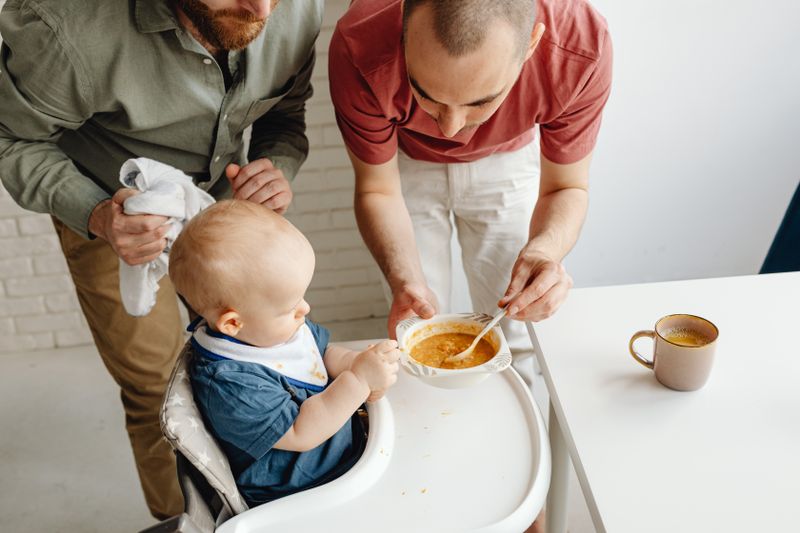
One small offering a day, at a time when nobody is hungry or rushed, is a more realistic starting point than three meals. A baby who has just had milk is more likely to be curious than a baby who is hungry, which is counterintuitive and widely suggested. Repeated exposure matters more than immediate acceptance, and foods refused several times are commonly accepted later.
On almost no sleep, the mess is unavoidable and planning for it is easier than fighting it, which mostly means a mat under the chair and a bib with sleeves.
Sitting the baby with the family while everyone eats does more for the process than anything done with a spoon.
What not to turn it into
The fastest way to make weaning difficult is to introduce pressure, encouragement games or any sense that a quantity must be achieved. Babies are generally allowed to regulate how much they take, and this is one of the areas where interfering tends to backfire.
Comparisons with other babies are particularly unhelpful here, since the spread in how quickly babies take to solids is very wide. A period of apparent regression, where a baby who was eating stops, is common and usually short. If eating is genuinely not progressing, or you are concerned about it, that belongs with a health visitor rather than with more effort at home.
Safety and the things to ask about
Choking risk, which foods to avoid, salt and sugar, allergens and how food should be prepared are all covered by national guidance. Those rules differ by country and are updated, so read the current version published where you live rather than an article about it.
Learning what to do if a baby chokes is worth doing properly through a first aid course rather than from written descriptions. Gagging and choking are different things and are frequently confused, and this is another reason a practical course is more useful than reading. Anything about your particular baby, including any history that might be relevant, should go to a health professional before you start.
The takeaway
Treat the first month as practice with a mess mat, keep the milk going, and take the safety rules from your own country's guidance.
The good-enough version, done calmly, is the one that helps.
Questions readers ask
How much should a baby eat when starting solids?
Quantity is not the point in the early weeks, and milk continues to provide the great majority of nutrition. Any concern about intake belongs with your health visitor.
When should we start?
Guidance differs by country and describes readiness rather than a fixed date. Take it from the health body where you live and ask your health visitor about your baby.