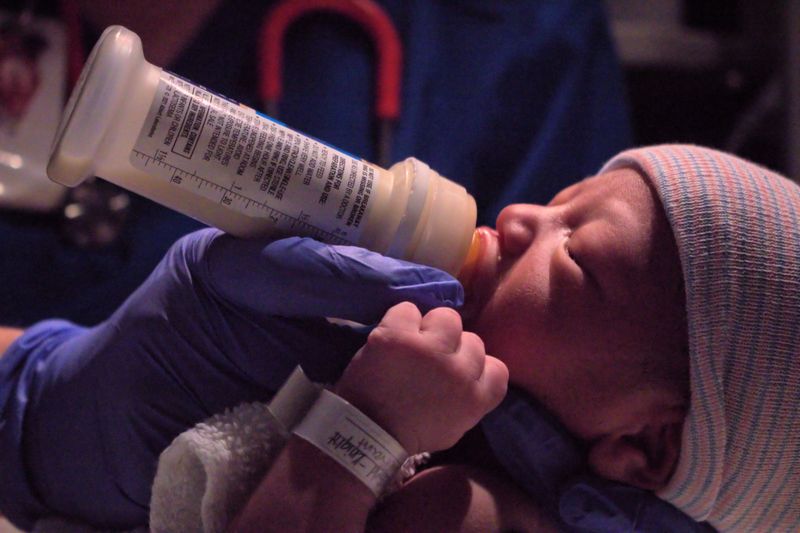
Feeding
How Milk Supply Responds To Demand
Milk production is governed by how much milk leaves the breast rather than by how much is eaten or drunk, which is why removal drives the whole system.

Milk production runs on a removal signal rather than on effort or diet. Understanding that one relationship explains most of what parents are told about supply, and most of what confuses them.
Removal is the instruction, not the request
The breast does not decide in advance how much to make. It responds to how completely and how often milk is taken out, adjusting production over the following days to match what has been leaving.
A feed that empties the breast well sends a stronger signal than a brief one. Frequency matters for the same reason, since long gaps between removals read as an instruction to slow down.
This is why the advice given to a parent worried about supply almost always concerns timing and effectiveness of feeds rather than food, fluids or willpower on the parent's part.
The feedback works locally in each breast
Milk itself carries a protein that accumulates as milk sits in the breast and suppresses further production. Take the milk out and the suppressor goes with it, so production picks back up.
Because the signal travels in the milk rather than the bloodstream, each breast keeps its own accounting. One side commonly produces more than the other, and that asymmetry is ordinary.
It also explains why a baby who strongly prefers one side can gradually shift the balance. The busier side is being told to keep going while the quieter side is told to wind down.
The early weeks set a working baseline
Hormonal changes at birth start production regardless of what the baby does. The switch to demand-driven control happens over the following weeks, which is why the early period gets so much attention.
Frequent removal during that window is thought to influence how responsive the system stays later. The mechanism involves receptors in breast tissue that are laid down while feeding is being established.
None of that makes the early weeks a single chance. Supply can be built or rebuilt later, but the work is usually harder and slower than establishing it at the start.
A pump measures itself, not the breast
Pump output is a common source of alarm because it looks like a number. What it actually measures is how well that pump, at those settings, with that flange, removed milk on that occasion.
Babies and pumps do not extract milk the same way. A parent can produce plenty and still pump little, and the reverse happens too, which makes the volume in the bottle a weak proxy.
More reliable indicators are the ones a clinician tracks over time, including weight measured on a professional's scale and the pattern of wet and dirty diapers.
When the question stops being mechanical
Supply concerns sometimes have causes that no amount of feeding technique addresses, including medical conditions in either parent or baby and problems with how the baby latches or transfers milk.
That is the point at which a pediatrician or a lactation consultant is doing something an article cannot. They can watch a feed, weigh the baby and examine both people involved.
The value of understanding the mechanism is knowing which questions to bring, not substituting for the visit. Slow weight gain in particular is a reason to be seen promptly rather than to wait.
Questions readers ask
When should allergens be introduced?
This differs by country and has been revised, so take it from the health body where you live. If there is any family history of allergy, speak to a professional first.
My mother says to delay certain foods. Is she right?
She may be describing advice that was current when she was following it. Guidance has changed in several countries, so check the current version published where you live.
Also by Shalu Prasad
- The fourth trimester is a framing, not a diagnosis, and it helps anywayThe Newborn Weeks
- Nobody warns you about the two-week visitor waveThe Newborn Weeks
- The first fortnight at home is a logistics problem nobody set up for youThe Newborn Weeks
- Crying often peaks in the early weeks before it easesThe Newborn Weeks