Gear & Nursery
Toys under one year: contrast, texture and the box they came in
The developmental toy market is enormous and the evidence behind its specific claims is thin. What babies actually engage with is simpler and usually already in the house.
These are listed in the order worth acting on, which with toys in the first year is not the order they are usually presented in.
What matters most
- Interaction with an adult outperforms any object.
- Safety standards and choking sizes matter more than developmental claims.
- Household objects are frequently more engaging than purchased toys.
What babies actually respond to
Very young babies respond most to faces, and no toy has ever competed with an adult who is looking at them and talking. Early visual preference is for high contrast and simple shapes rather than for detail or subtle colour, which is why black and white cards are commonly suggested. As grasping develops, texture, weight and sound become the interesting properties, and objects that do something when handled hold attention longest.
By the second half of the year, containers, lids, things that go inside other things and anything an adult uses become the main attraction. None of this requires a developmental toy, and most of it is already present in a kitchen.
The claims on the box
Toys marketed on brain development, IQ or accelerated milestones are making claims that the evidence does not generally support. What is consistently associated with development is interaction, opportunity to move and responsive adults, none of which come in a box. That does not make toys pointless; it makes the specific developmental claims marketing rather than information.
A toy that a baby enjoys is worth having on those grounds alone, without needing a developmental justification. Being sceptical of the claims saves money that is better spent elsewhere in a year with a lot of expenses.
Safety before anything else
Everything a baby can reach goes in the mouth, which makes size, small parts and material the questions that actually matter. Toys sold in most countries carry safety markings and age labelling, and the age labelling is frequently about choking risk rather than capability. That means a toy marked for older children is not a challenge to attempt early; it is a hazard warning.
In the small hours, batteries, particularly button cells, are a serious hazard and battery compartments should be secured with a screw. Check for recalls on anything secondhand, and be cautious about toys bought from unregulated online marketplaces where standards may not have been met.
Household objects
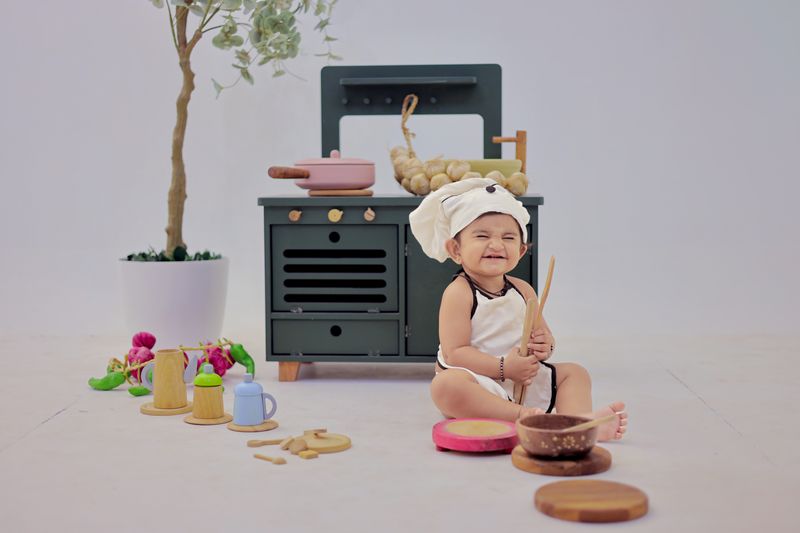
Wooden spoons, plastic bowls, empty boxes, saucepan lids, muslins and cardboard tubes are reliably more interesting than most purchased toys. They also cost nothing and can be replaced when they are inevitably destroyed or dropped somewhere unrecoverable. The requirements are the same as for toys: too large to swallow, no small parts, nothing sharp, nothing that could trap fingers.
A drawer or low cupboard filled with safe household items becomes a reliable ten minutes of occupation in the second half of the year. The joke about the box being better than the present is repeated because it is consistently true at this age.
Rotation and volume
Babies engage more with a small number of available objects than with a large number spread across a floor. Keeping most toys out of sight and swapping a few every week or two makes familiar objects interesting again for nothing.
Once feeding settles, it also reduces the tidying, which is a real consideration once the floor is the main play area. Gifts arrive in volume during the first year, and quietly storing some for later is entirely reasonable. A box of things you have not yet introduced is more useful in month nine than a floor covered in month two.
This is practical, non-medical writing; your midwife, health visitor or paediatrician is the right source for anything clinical.
Books and screens
Books work from very early on, and what is happening is the interaction and the voice rather than the content of the story. Board books and cloth books survive being chewed, which is what first-year books are principally for. Guidance on screen use for babies exists in several countries and generally recommends very limited or no screen time under a certain age.
Take that guidance from your national health body rather than from an article, since the specifics differ. What is uncontroversial is that a screen does not respond to a baby specifically, and responsiveness is what the interaction is doing.
Everything above, in order of what to do first
- What babies actually respond to. Very young babies respond most to faces, and no toy has ever competed with an adult who is looking at them and talking.
- The claims on the box. Toys marketed on brain development, IQ or accelerated milestones are making claims that the evidence does not generally support.
- Safety before anything else. Everything a baby can reach goes in the mouth, which makes size, small parts and material the questions that actually matter.
- Household objects. Wooden spoons, plastic bowls, empty boxes, saucepan lids, muslins and cardboard tubes are reliably more interesting than most purchased toys.
- Rotation and volume. Babies engage more with a small number of available objects than with a large number spread across a floor.
- Books and screens. Books work from very early on, and what is happening is the interaction and the voice rather than the content of the story.
The takeaway
Buy very little, check the age labelling as a safety warning rather than a challenge, and keep most of it out of sight to rotate.
Nothing in the first year lasts, including the parts that feel permanent at three in the morning.
Questions readers ask
Do developmental toys actually help?
The evidence behind specific product claims is thin. Interaction, floor time and responsive adults are what development is consistently associated with.
What is the best toy for a newborn?
A face. High-contrast cards and simple objects come next, and household items work as well as purchased ones once grasping develops.
Also by Priyamvada Lakra
- What actually fits in a changing bag, and what comes straight back outGear & Nursery
- Babbling is already language, several months before the first wordGrowing & Milestones
- Standing, cruising, and the long quiet gap before walkingGrowing & Milestones
- The pram that folds one-handed beats the pram with better reviewsGear & Nursery