Growing & Milestones
Standing, cruising, and the long quiet gap before walking
Pulling up to stand arrives dramatically, and then a great deal appears to happen slowly. The work going on in that gap is balance, and it cannot be hurried.

This is less a set of instructions about pulling up and cruising than an argument, and it is worth saying so at the start.
The argument in brief
- Pulling to stand comes well before independent walking.
- The gap between them is spent on balance rather than strength.
- Baby walkers are restricted or discouraged in several countries.
The sudden part
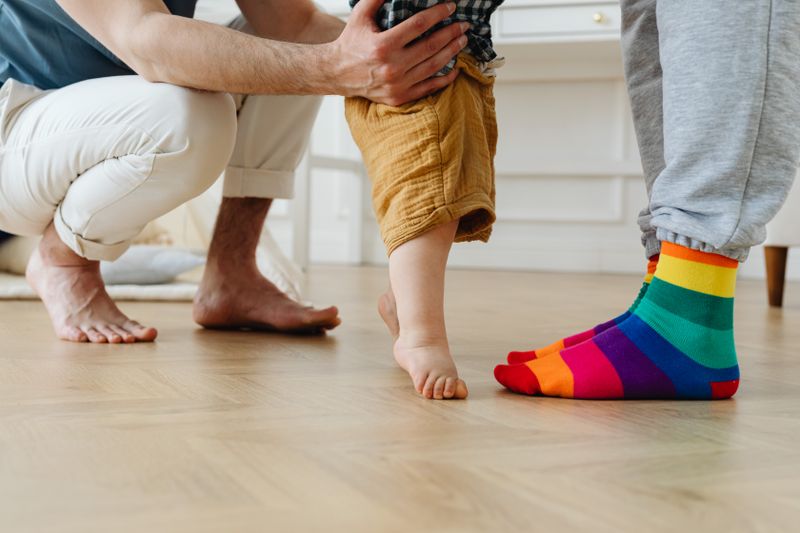
Pulling up to stand tends to arrive abruptly, with a baby who was sitting yesterday now upright and holding onto the sofa. It usually appears before the baby has any idea how to get back down, which produces a memorable period of being stuck.
Getting down is a separate skill and is worth practising deliberately, since it removes most of the crying associated with this stage. It also frequently arrives alongside a period of disrupted nights, with babies pulling up in the cot at three in the morning. That period passes as the descent becomes automatic, usually within a couple of weeks.
Cruising
Moving sideways along furniture while holding on is the next stage and can continue for a long time before anything else changes. During cruising a baby has their weight supported by their arms, which means the balance problem has not yet been solved. The transition to walking involves shifting weight fully onto one leg while the other moves, which is a genuinely difficult balance task.
Once feeding settles, that is why the gap between cruising confidently and walking independently can run to months without anything being wrong. Watching for a baby to let go with one hand, then to stand unsupported briefly, is the actual progression to look for.
The range for walking
Independent walking appears across a very wide age range, and both ends of that range are entirely ordinary. Babies who bottom-shuffle often walk later, which is a recognised pattern rather than a cause for concern. Babies born early are considered against adjusted age, which shifts the whole picture by however many weeks.
The age a baby walks does not predict anything meaningful about later coordination or ability, despite what an enthusiastic relative may say. If walking has not appeared by the point your health visitor would expect it, that is a conversation to have rather than a crisis.
Shoes and floors
Barefoot is generally recommended indoors while a baby is learning, since feet grip better and provide more sensory feedback. Shoes are for outdoors and protection rather than for support, and guidance in most countries reflects that. First shoes should be fitted properly, since baby feet are soft and a poorly fitted shoe is worse than none.
Around the four-month mark, socks on hard floors are the single most common cause of avoidable slipping at this stage.
Anything about foot development, gait or how a baby is standing should go to a health professional rather than a shoe shop.
Walkers and equipment
Baby walkers are restricted, discouraged or subject to safety warnings in several countries, largely because of injury risk. Check what the guidance says where you live before buying or accepting one, because the position is stronger than most people realise. Stationary activity centres are a different product and have their own manufacturer guidance on age and duration.
The general principle across guidance is that time in any container is limited and the floor does the developmental work. Push-along toys that a baby steers themselves are a different matter and are widely regarded as fine once a baby is stable.
Milestone ranges are wide, and where one baby sits inside a range says very little on its own.
The house at standing height
A baby who can pull up can reach an entirely new band of the house, including table edges, hot drinks, cables and anything on a low shelf. This is the point at which furniture anchoring becomes urgent, since a baby pulling up on a bookcase can bring it over. Most countries publish home safety guidance covering exactly this stage, and it is more thorough than an improvised check.
Around the four-month mark, stair gates become relevant here, and fitting them before they are needed is much easier than fitting them afterwards. Doing a survey from the baby's new height, rather than from standing, finds the things that will otherwise be found the hard way.
The takeaway
Let them practise getting down as much as getting up, anchor the furniture before they pull on it, and stop counting weeks until walking.
Nothing in the first year lasts, including the parts that feel permanent at three in the morning.
Questions readers ask
My baby cruises but will not let go. How long does that take?
The gap between cruising and walking is a balance problem and can run to months. It varies widely and is not something that can be hurried.
Are baby walkers a good idea?
They are restricted or discouraged in several countries because of injury risk. Check the guidance where you live before buying or accepting one.
Also by Priyamvada Lakra
- What actually fits in a changing bag, and what comes straight back outGear & Nursery
- Babbling is already language, several months before the first wordGrowing & Milestones
- The pram that folds one-handed beats the pram with better reviewsGear & Nursery
- Car seats are the one purchase where secondhand is a bad ideaGear & Nursery