Growing & Milestones
Hand control develops outwards from the shoulder
Babies do not learn to use their hands all at once. Control spreads from the trunk outwards, which explains almost everything about how early grabbing looks.

Treat the sections below as a sequence. With developing hand control, getting the early decisions right makes the later ones much easier.
Before you start
- Control develops from the centre of the body outwards.
- Early reaching uses the whole arm before the hand refines.
- The pincer grip appears late in the first year and changes everything.
The direction of travel
Motor control generally develops from the centre of the body outwards, so shoulders become controllable before elbows, and elbows before wrists and fingers. That is why an early reach looks like a whole arm being swung at an object rather than a hand being placed on it.
The same principle explains why a baby can bat at a toy long before they can pick one up deliberately. Understanding the direction makes the sequence predictable, which removes a lot of the guesswork about what comes next. The timing, as with everything else in the first year, varies across a range wide enough that quoting weeks would mislead.
Grasping before choosing
Newborns grip anything placed in the palm, and that early grip is reflexive rather than a decision the baby is making. That reflex fades over the first months, and what replaces it is a deliberate grasp under the baby's own control. The transition is easy to miss and is one of the more genuinely significant changes of the first half of the year.
A deliberate grasp is the point at which a baby can start investigating the world rather than simply receiving it. It is also the point at which anything within reach becomes something that will end up in the mouth.
Everything goes in the mouth
Mouthing is a major route for exploration, since the mouth has far more sensory resolution than the hands do at that stage. That is why babies mouth objects long before they can examine them with their fingers, and it is normal rather than a habit to discourage. The practical consequence is that small objects, batteries, cords and anything that fits in a mouth become a genuine safety matter.
Guidance on choking hazards and safe toy sizes exists in most countries and is worth reading before the mobile stage rather than after. Learning infant first aid properly on a course is the sensible companion to that reading.
The whole-hand stage
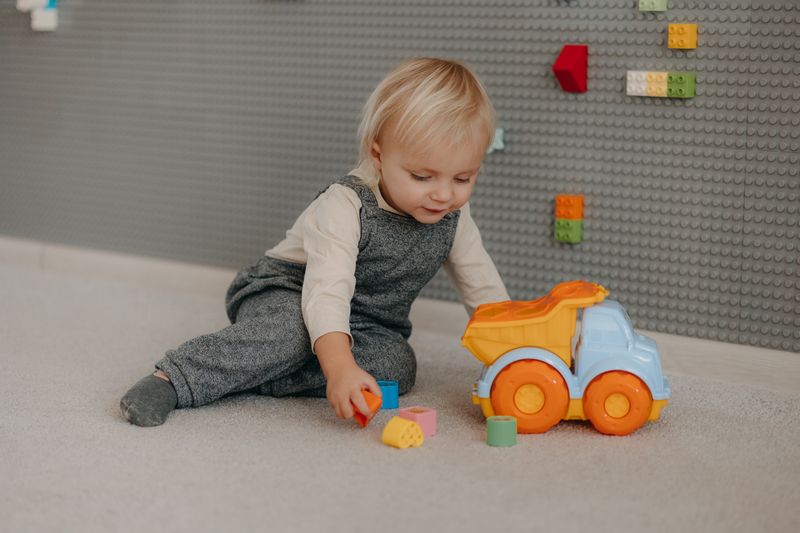
For a period, babies pick things up by pressing them against the palm with all the fingers together, which works badly for small objects. This is why a baby at that stage will happily hold a large toy and be entirely defeated by a piece of cereal. The thumb gradually starts working independently, which is a substantial mechanical change and considerably widens what can be picked up.
In the small hours, transferring an object from one hand to the other is another distinct step and appears somewhere in the middle of the year.
Each of these looks minor and each is a genuine reorganisation of how the hand is being controlled.
The pincer grip
Late in the first year most babies develop the ability to pick up small objects between thumb and forefinger. This is the change that makes self-feeding practical and it is why finger food becomes much more successful around then. It is also the change that makes a floor dangerous, since a baby who can pick up a crumb can pick up anything else that size.
A sweep of the floor at baby eye level, done from the floor rather than from standing, finds things that are otherwise invisible. The age at which this appears varies widely, and babies born early are considered against adjusted age.
Safe sleep and feeding guidance is set nationally and updated periodically, so follow the current official guidance where you live over anything general.
What actually helps
Opportunity is the main thing: objects of different sizes, weights and textures within reach, and time on the floor to work at them. Household objects are generally more interesting than toys and cost nothing, provided they are safe and appropriately sized. Equipment that occupies the hands, or holds the baby in a position where they cannot reach, reduces the practice available.
Week by week, there is no need to buy anything marketed at fine motor development, since the evidence for specific products is thin. If you have any concern about how a baby is using their hands, particularly a marked preference for one side, raise it with a professional.
The takeaway
Give them safe things of different sizes within reach and floor time to work at them, and let the sequence run from shoulder to fingertip.
Nothing in the first year lasts, including the parts that feel permanent at three in the morning.
Questions readers ask
Should my baby prefer one hand?
A strong, consistent hand preference in the first year is something worth mentioning to your health visitor or doctor rather than assuming.
How do I encourage fine motor development?
Opportunity rather than equipment: varied safe objects within reach and plenty of floor time. Specific developmental toys have little evidence behind their claims.