Growing & Milestones
Sitting up is a balance problem the trunk solves over weeks
Sitting looks like a single achievement and is actually a gradual accumulation of trunk strength and balance reactions. That is why it arrives in stages rather than on a day.

There is a short answer about learning to sit and a useful one, and they are not the same. What follows is the useful one.
The short version
- Propped sitting, independent sitting and sitting from lying are separate steps.
- Falling sideways is part of the process, so the floor matters.
- Seats that prop a baby up reduce the practice that builds the skill.
Three different things called sitting
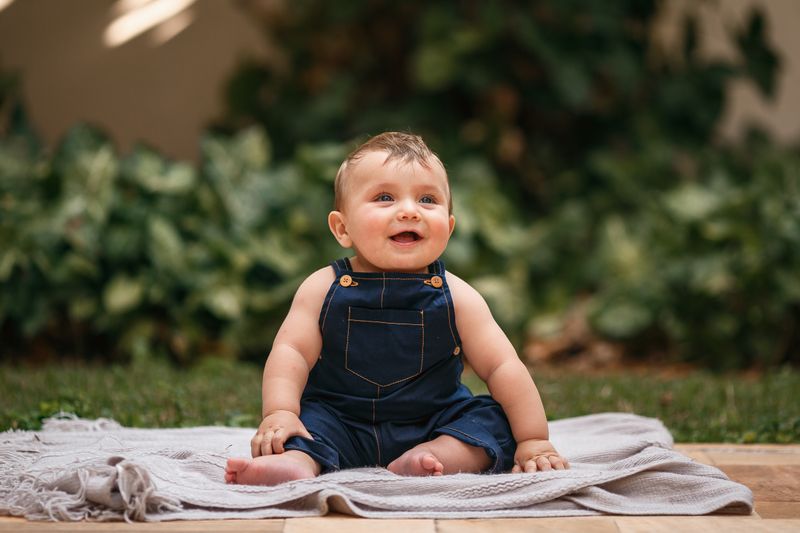
Being propped up and staying there is one thing; sitting unsupported is another; getting into a sitting position without help is a third. These arrive at different times, sometimes weeks apart, which is why parents disagree about when their baby started sitting.
Milestone lists usually mean unsupported sitting, but they rarely say so, which is a common source of confusion. The last of the three, getting into the position independently, is a substantial achievement that gets far less attention than it deserves. Knowing there are three steps makes the process legible rather than looking like a skill that keeps almost arriving.
What has to develop
Sitting requires enough trunk strength to hold the body upright and enough balance reaction to correct when it starts to tip. The strength comes largely from time spent on the front and the side, which is the direct link between tummy time and sitting.
Week by week, the balance reactions develop through practice at losing balance, which means falling over is part of the mechanism rather than a failure. Babies typically go through a period of sitting with hands planted forward, which is the trunk borrowing support from the arms. Freeing the hands from that duty is what turns sitting into a position from which a baby can actually do things.
Why the floor matters
A baby learning to sit will topple sideways and backwards repeatedly, which is expected and is how the corrections get learned. That is a strong argument for practising on the floor with something soft behind rather than on a sofa or a bed.
A horseshoe cushion is popular and does help, though propping a baby into a position they cannot yet hold has limited developmental value. Supervision is the actual requirement, since a baby who has just learned to sit will fall from it without warning. Sitting on a raised surface is the situation to avoid entirely until the position is genuinely stable.
What sitting changes
Sitting frees the hands, which transforms what a baby can do with objects and makes play considerably more sophisticated. It also changes the view of the room, which is a genuine shift in how much of the world a baby can observe.
For a first baby, many parents report a noticeable change in mood around this point, since a baby who can sit is much less dependent on being held to see anything. It is usually the stage at which a baby starts seeming like company rather than a small dependent object.
It also brings the highchair into use, which is its own set of purchases and its own mess.
Equipment that gets in the way
Seats, bouncers and floor chairs that hold a baby upright provide the position without providing the practice that produces it. Used briefly they are harmless and genuinely useful for an adult who needs both hands for ten minutes. Used for long stretches they reduce the floor time that motor development is consistently associated with.
Week by week, some of these products have their own manufacturer guidance on duration and age, and it is worth actually reading it. The general principle across guidance is that containers are for short periods and the floor is for the rest.
If sitting is slow to arrive
The range for independent sitting is wide, and babies born early are considered against adjusted age rather than birth age. A baby who is progressing steadily but slowly is a different picture from one who is not progressing, and professionals distinguish between them.
Any concern about trunk strength, asymmetry or a baby who seems very floppy or very stiff should be raised promptly. These are things health visitors and doctors assess routinely, and referral routes to physiotherapy exist in most systems. A scheduled review is the natural place to ask, and asking sooner is entirely reasonable.
The takeaway
Practise on the floor where falling over is free, and keep the seats and bouncers to short stretches.
The good-enough version, done calmly, is the one that helps.
Questions readers ask
Should I prop my baby up to help them sit?
Brief supported sitting is fine, but the skill is built by practising balance on the floor. Long periods propped in a seat reduce that practice.
My baby keeps falling over when sitting. Is that normal?
Losing balance is how the corrections get learned, which is why the floor with something soft behind is the right place to practise. Any concern about strength or balance should go to your health visitor.
Also by Shalu Prasad
- The fourth trimester is a framing, not a diagnosis, and it helps anywayThe Newborn Weeks
- Nobody warns you about the two-week visitor waveThe Newborn Weeks
- The first fortnight at home is a logistics problem nobody set up for youThe Newborn Weeks
- Crying often peaks in the early weeks before it easesThe Newborn Weeks