Gear & Nursery
Baby clothes sizing is measured in months and means nothing of the sort
A label saying three to six months describes a manufacturer's idea of a body, not an age. Buying by age is why half the wardrobe never gets worn.

The options around baby clothes sizing are set out side by side below, with the conditions that genuinely favour one over the other.
The difference in one place
- Age labels vary enormously between brands and countries.
- Height and weight ranges on the label are more informative than the age.
- Buying ahead in the wrong season wastes more clothes than anything else.
The label is not an age
A size marked three to six months describes garment dimensions that one manufacturer associates with that age range in their own market. Because babies of the same age differ enormously in size, the age on the label predicts fit poorly for a substantial share of babies. Brands also size differently from each other, so the same age label from two shops can differ by a noticeable margin.
Sizing conventions differ between countries as well, which matters increasingly when buying online from abroad. The practical consequence is that a wardrobe bought by age contains a lot of items that fit for a fortnight or never.
Read the height and weight instead
Most labels carry a height range and often a weight range, and these are considerably more useful than the age. Knowing your baby's current length and weight, roughly, turns clothes shopping from guesswork into matching numbers.
Height is generally the better guide for sleepsuits and anything full-length, since length runs out before width does. For a baby who is long and slim, or short and solid, the age label will be wrong in a predictable direction that is easy to correct for. Once you know which brands run large or small for your baby, buying becomes much more efficient.
The season problem
The most common waste is buying ahead and discovering that the size fits in a season it was not designed for. A summer outfit in six to nine months is useless if your baby reaches that size in January, which is easy to work out and easy to forget.
On almost no sleep, sale shopping and gifts both push heavily in this direction, since both are driven by what is available rather than what will fit when. A rough note of which size is likely in which month makes buying ahead sensible rather than speculative. For gifts, telling people the size and season you will actually need is far more useful than letting them guess.
Features that matter more than looks
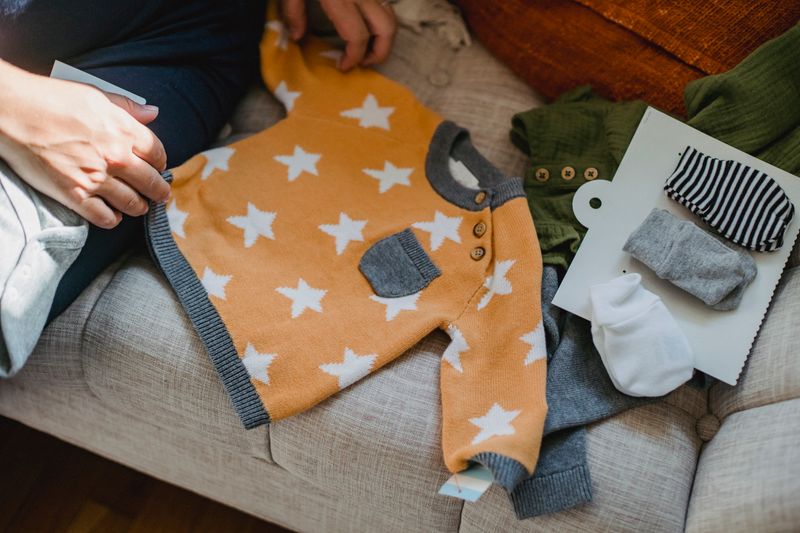
Poppers along the inside leg turn a nappy change into a thirty-second job, and clothes without them require full undressing. Envelope necklines are designed to be pulled downwards over the shoulders rather than over the head, which matters after a nappy incident. Integrated scratch mitts on sleeves are useful in the newborn weeks and are frequently missing from the nicest-looking items.
Week by week, zips are faster than poppers and are much harder to misalign at four in the morning, which is a genuine advantage.
Anything with buttons at the back, stiff denim or a bow that presses into a car seat will be worn once for a photograph.
How much is actually needed
The newborn stage is short and the quantity needed depends almost entirely on how often you do laundry. A working set of sleepsuits and vests in each of the first two sizes covers the great majority of the first months. Outfits are largely for other people, since a baby is more comfortable and easier to change in a sleepsuit.
Buying a small quantity of the first size and seeing how quickly it is outgrown is the low-risk approach. Almost every household ends up with more newborn clothing than it uses, and almost none regret buying too little.
Milestone ranges are wide, and where one baby sits inside a range says very little on its own.
Secondhand and passing on
Baby clothes are worn for weeks and last for years, which makes the secondhand market unusually good value. Sizes above newborn are frequently barely used, since the fastest growth is at the start. Accepting a bag of clothes from someone whose child is a year older is one of the better forms of help to say yes to.
Once feeding settles, sorting by size into labelled bags as things are outgrown saves an enormous amount of time later. Sleepwear is the one category worth checking against your national flammability requirements when acquiring secondhand.
Side by side
| Consideration | What it means in practice |
|---|---|
| The label is not an age | Age labels vary enormously between brands and countries. |
| Read the height and weight instead | Height and weight ranges on the label are more informative than the age. |
| The season problem | Buying ahead in the wrong season wastes more clothes than anything else. |
The takeaway
Buy by height and weight rather than age, think about which season each size will land in, and take every bag of hand-me-downs offered.
The good-enough version, done calmly, is the one that helps.
Questions readers ask
Why does the same size fit differently between brands?
Manufacturers size to their own conventions and to different markets. Use the height and weight ranges on the label rather than the age.
How many newborn outfits do we need?
Fewer than most people buy. Sleepsuits and vests in a quantity that matches how often you do laundry covers almost everything.
Also by Shalu Prasad
- The fourth trimester is a framing, not a diagnosis, and it helps anywayThe Newborn Weeks
- Nobody warns you about the two-week visitor waveThe Newborn Weeks
- The first fortnight at home is a logistics problem nobody set up for youThe Newborn Weeks
- Crying often peaks in the early weeks before it easesThe Newborn Weeks