Feeding
Feeding in public: the practical version rather than the political one
Most of the writing on this subject is about rights and attitudes. The thing parents actually need is where to sit, what to wear and how long you have.

This works through feeding a baby in public in the order the parts actually depend on each other.
The short version
- Legal protections for feeding in public vary by country.
- Clothing and seating solve most of the practical difficulty.
- Scouting one reliable spot per regular destination removes the stress.
The practical problem
A baby will need feeding while you are out, and the difficulty is almost never the feeding itself but the logistics around it. Somewhere to sit, somewhere to put the bag, a back that is supported and the ability to get up again cover most of it.
For bottle feeding the additional questions are preparation, temperature and what the guidance where you live permits when away from home. These are solvable in advance, which is what turns the first outing from an ordeal into an errand. The political conversation is a separate matter and it does not help you at the point you are standing in a shopping centre.
Rights differ by country
Many countries have legal protections for feeding a baby in public places, and the scope of those protections differs considerably. Some cover all public spaces, some are narrower, and enforcement in practice varies regardless of what the law says.
Knowing roughly what applies where you live is worth ten minutes, mostly because it removes the uncertainty rather than because you will need to invoke it. If you travel, the position may be different at the destination, which is worth a check before a long trip. Most parents never have an incident, and knowing where you stand makes the small chance of one much less daunting.
Clothing solves most of it
For breastfeeding, layering is the practical answer: a loose top lifted from the bottom with a vest underneath covers everything that concerns people. Specialist feeding clothing exists and works, and plenty of parents manage the whole year without buying any of it. Covers divide opinion sharply, are useful to some parents and actively objected to by some babies, so buying one before trying is optimistic.
Once feeding settles, the practical test is whether you can manage the whole thing one-handed while sitting down, since that is the situation you will be in. Practising at home once, in front of a mirror, removes most of the self-consciousness before it becomes a problem in public.
Scouting the places you go
Most parents converge on a small number of reliable spots and use them repeatedly rather than solving the problem afresh each time. A café with soft seating and a tolerant attitude, a library, a department store with a parents' room and a quiet corner in a park cover most needs.
In the small hours, shopping centres and large stores often have dedicated facilities, and their quality varies from excellent to a chair in a toilet. Asking staff directly is usually faster than looking, and in most places the answer is helpful rather than awkward.
Having one known spot per regular destination is the single thing that makes going out feel routine rather than risky.
Bottles away from home
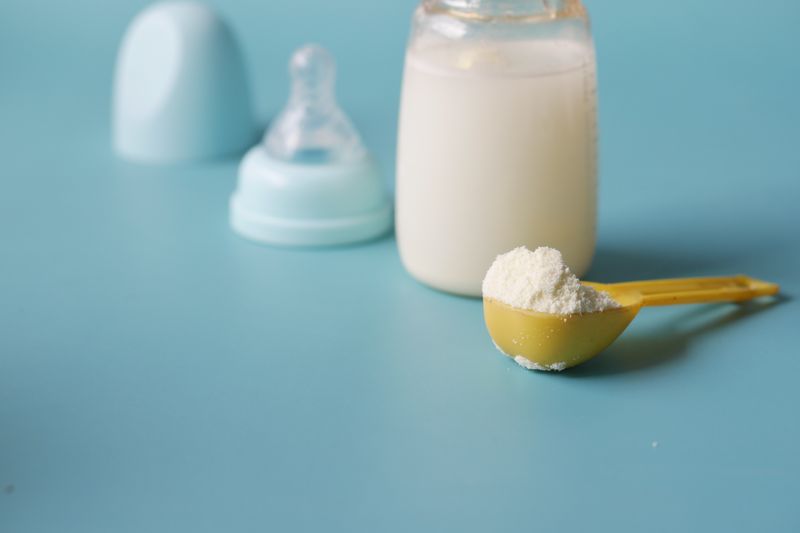
Preparation and transport of formula away from home is covered by official guidance in most countries, and it is genuinely worth reading before relying on a workaround. The usual options are pre-measured powder with separately carried water, insulated flasks, or ready-to-feed liquid for occasional use. Warming is frequently the practical obstacle, and many babies will take a feed cooler than a parent expects, though that varies.
Cafés vary in whether they will provide hot water, and asking politely usually works better than assuming either way. Anything about temperature, storage times or safety should come from your national guidance rather than from an article.
If you are worried about feeding, breathing, temperature or how a baby is behaving, contact a health professional straight away rather than reading on.
If someone says something
It happens rarely, and when it does the most effective response is usually a short one followed by carrying on with what you were doing. Staff in most venues will support you if asked, and escalating to a manager is more effective than arguing with another customer.
Around the four-month mark, you are not obliged to educate anybody, move, or justify yourself, and disengaging is a legitimate choice rather than a defeat. It is worth mentioning afterwards to someone who will be supportive, because these incidents land harder than they should. Almost every parent who feeds out of the house does so for a year without any incident at all.
The takeaway
Sort the clothing, find one reliable spot per place you go regularly, and take the bottle rules from your own country's guidance.
Nothing in the first year lasts, including the parts that feel permanent at three in the morning.
Questions readers ask
Am I legally allowed to breastfeed in public?
Many countries have protections, but the scope differs. Check what applies where you live, and where you are travelling to if you are going abroad.
Can I make up a bottle in advance for a day out?
This is covered by official guidance and the rules differ by country. Take it from the health body where you live rather than from general advice.
Also by Shalu Prasad
- The fourth trimester is a framing, not a diagnosis, and it helps anywayThe Newborn Weeks
- Nobody warns you about the two-week visitor waveThe Newborn Weeks
- The first fortnight at home is a logistics problem nobody set up for youThe Newborn Weeks
- Crying often peaks in the early weeks before it easesThe Newborn Weeks